


Global partnerships power Kinetic’s next generation fleet
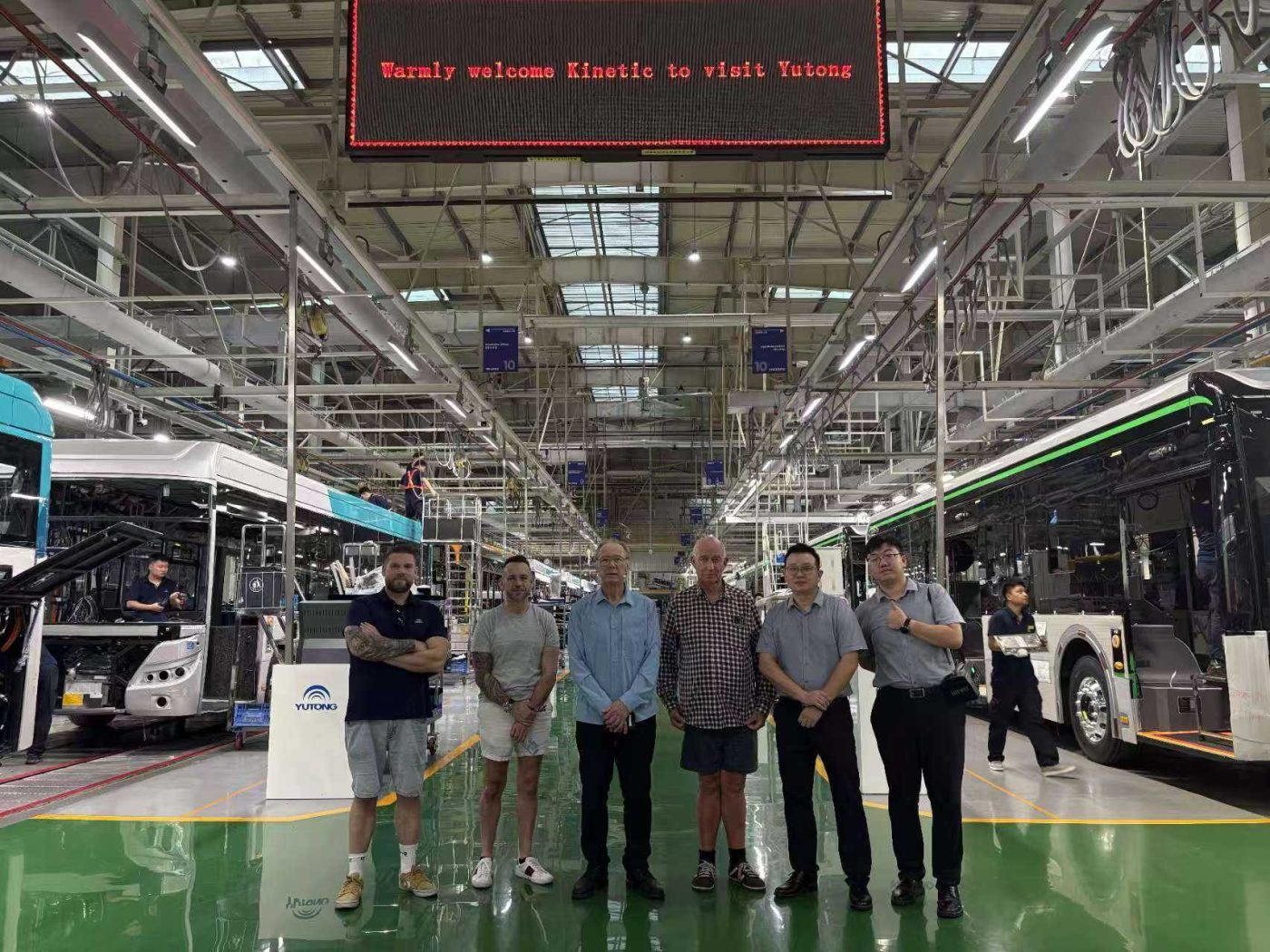
Earlier this year, senior members of Kinetic New Zealand travelled to China to explore global manufacturing capability and innovation in electric buses. The delegation included Ian Gordon (Director – Engineering, Infrastructure & Procurement), Craig Worth (Director – Fleet), and Kayne Baas (Executive General Manager – Electrification ANZ), who toured major facilities operated by CRRC, Yutong, and King Long to gain insight into the next generation of zero-emission public transport.
Over several days, the team visited the Changde Factory, the Zhuzhou Institute, and the Zhuzhou Intelligent Manufacturing Factory. They inspected production lines for drive motors, high-voltage controllers, and composite bus bodies, as well as testing and quality-assurance centres where the latest generation of components is validated.
“The scale and pace of innovation in China’s electric-vehicle sector are extraordinary,” said Ian Gordon. “The level of research investment and engineering talent is setting new global benchmarks.”
At Yutong’s Zhuzhou facility, they examined a test vehicle that had completed 300,000 kilometres of endurance testing, with body panels removed to expose structural stress points. The inspection demonstrated how leading Chinese manufacturers are achieving international standards of strength, safety, and reliability.
New Zealand’s operating environment, however, demands unique specifications. With narrower roads, lower height limits, and an aggressive coastal climate, buses must be lighter and more corrosion-resistant than many of those built for China’s domestic market. For that reason, our procurement and fleet teams emphasise the importance of stainless-steel or aluminium frames and composite bodies designed for a 20-year lifespan, rather than the eight-year average common in Asia.
“What stood out across the manufacturers we met with was their ability to adapt,” said Ian. “Engineers at the manufacturers we visited showcased their ability to customise configurations and materials to meet New Zealand’s unique requirements – from adapting axle loads and suspension geometry to refining control systems. For Kinetic, that flexibility underscored the value of partnership over procurement.”
“We don’t just buy buses,” Gordon added. “We work with manufacturers who share our commitment to collaboration and long-term performance.”
The visit also formed part of an RFP process to identify suitable suppliers for articulated electric buses for Greater Wellington Regional Council, giving the team insight into global capability and innovation. (Read more about the selected supplier).
The trip reaffirmed Kinetic’s confidence that international cooperation is key to delivering cleaner, smarter transport. As the company moves toward its target of a fully zero-emission urban bus fleet by 2035, these global relationships will play a crucial role in supporting local outcomes – from quieter streets to more sustainable cities.
“The future of public transport won’t be defined by where technology originates,” Gordon added, “but by how we work together to make it serve people better.”